
Data Advisory / Company Data Licensing / October 2026
Your Company Does Not Need to Be a Tech Business to License Data for AI
Six assumptions to reconsider before dismissing the commercial potential of your company’s operating history.
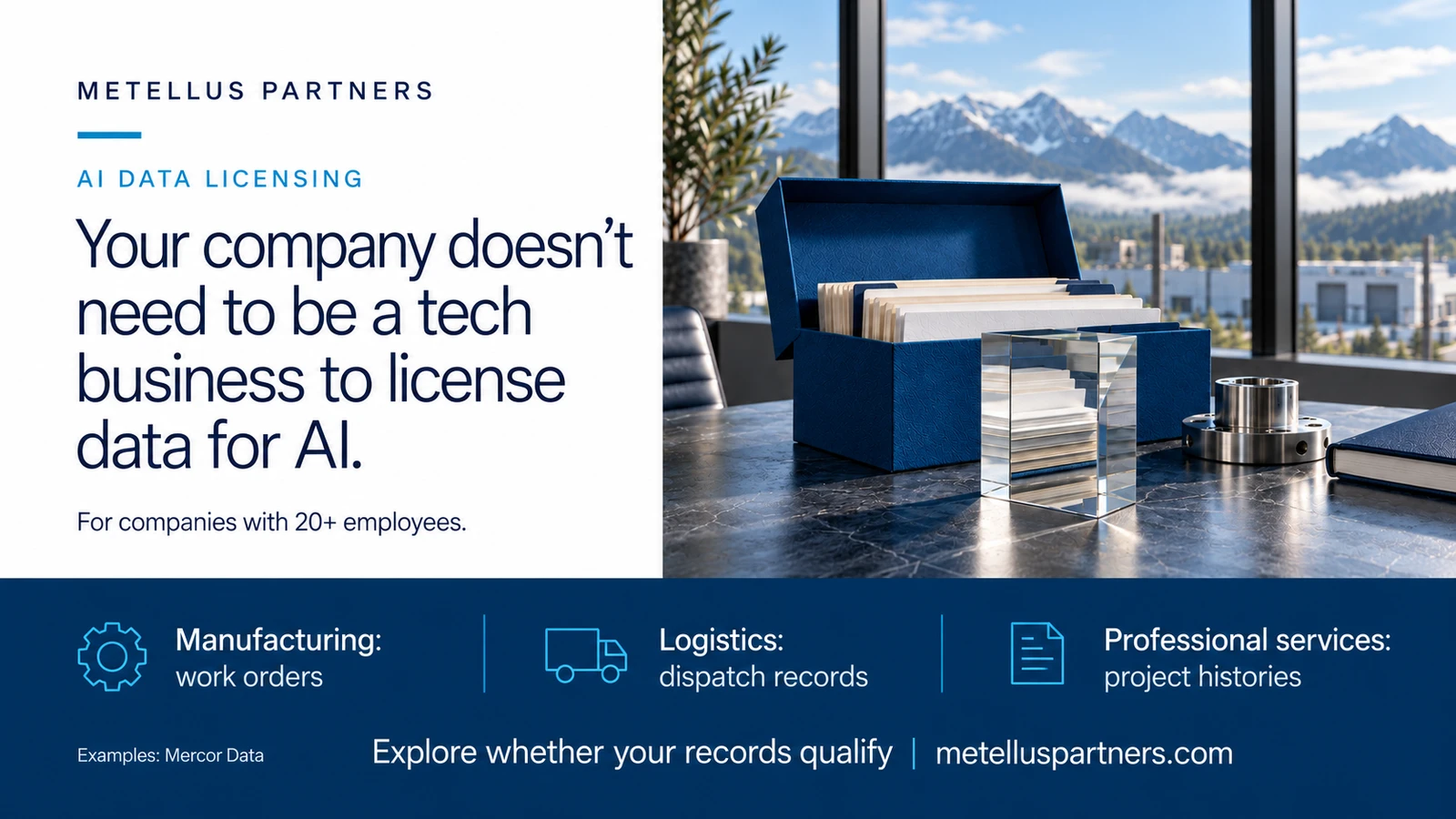
Business records beyond the technology sector
A manufacturer’s work orders, a logistics company’s dispatch records and a professional services firm’s project history are all categories of data being sought through an AI data-licensing program today. Mercor lists these examples among its target industries. Mercor
For a business owner, that creates a reason to look beyond the familiar value of those records inside the company.
The history of how work gets done can also be relevant to organizations developing AI for business tasks. Whether a particular archive has commercial value requires assessment, but being outside the technology sector is no reason to dismiss the opportunity.
Before ruling out licensing, consider six assumptions that can lead owners to the wrong conclusion.
1. Only technology companies have relevant data
Mercor’s published program includes manufacturing, logistics, professional services and other established industries. Its stated interest is in records of business workflows. Mercor’s target industries
A useful starting point is to describe the work your company records: how a job progresses, where decisions are documented and which systems retain the history.
The distinction between “we sell a data product” and “we hold records of real work” matters. An operating business can belong to the second category without ever having considered itself a data company.
2. Selling data means giving up the original records
A licensing agreement can grant defined usage rights while leaving the original records with the business.
Scrimdata, for example, describes a model in which a company retains ownership and licenses an anonymized derivative for specified uses. Its published default is non-exclusive licensing. These are that provider’s stated terms, rather than a promise about every transaction. Scrimdata
Assess what a proposed agreement actually permits: who can use the material, for what purpose, for how long and under what restrictions. Continued internal use, exclusivity and onward licensing deserve explicit treatment.
“Selling our data” is too broad a phrase to settle those questions.
3. An initial enquiry requires uploading company files
You can start a conversation with Metellus Partners by describing your business and the systems holding its records.
Our Data Advisory enquiry form provides an entry point for that discussion. The first step is to establish whether a specialist assessment is worthwhile.
A description of your industry, approximate team size, software systems and years of operating history gives the conversation a starting point. Leave confidential records, credentials and customer-level details out of the enquiry.
Any later request for access or samples should follow an agreed scope and appropriate review. Exploring an opportunity does not require treating an initial contact form as a data-transfer channel.
4. More files automatically mean a higher price
Volume alone does not explain a dataset’s suitability.
Scrimdata describes connected operational history across systems as an important part of its assessment, and says valuation depends on breadth, depth and interconnection. Scrimdata’s assessment criteria
For an owner preparing an overview, explaining how records relate to one another is more informative than reporting a storage total alone. Describe whether the systems preserve the sequence of work, decisions and outcomes, alongside the period covered.
An archive still needs to match a buyer’s requirements. A large collection of files is not evidence of an offer, and an indicative estimate is not a payment commitment.
5. Removing names resolves every confidentiality issue
Anonymization requires more than assuming a file is safe because direct identifiers have been removed.
The UK Information Commissioner’s Office distinguishes anonymous information from pseudonymized information that remains identifiable using additional information. It also explains that the anonymization process itself is personal-data processing. The guidance is UK-specific and currently marked as under review. ICO guidance
Before proceeding, have the actual records, applicable requirements and contractual permissions assessed. Customer confidentiality and rights to third-party material belong in that review alongside privacy.
A provider’s description of its safeguards is a starting point for diligence. It does not establish that every record in your company’s systems is eligible for licensing.
6. Only a company closing down should explore this
An operating company can assess licensing while continuing to run its business. Scrimdata explicitly describes a route for operating companies alongside its work with wind-downs, exits and pivots. Scrimdata’s partner program
The commercial decision is whether the proposed payment justifies the rights granted, preparation effort and continuing obligations. A company does not need to wait for a financing deadline or a closure decision to examine that question.
Keeping the assessment separate from urgent cash needs also makes it easier to evaluate the terms on their merits.
Find out whether your company’s records warrant an assessment
For owners and executives of companies with 20+ employees, Metellus Partners offers an initial conversation about a specialist data-licensing introduction.
You do not need to arrive with a valuation or a packaged dataset. Start with a company overview and a description of the systems that record your work.
The 20-employee threshold describes the audience for this enquiry. It does not guarantee buyer acceptance, a minimum payment or eligibility for a particular program.
Submit a data-licensing enquiry
Use the form to tell us about your business. We can then discuss whether an introduction for specialist assessment makes sense.
Sources and references
Insights
Perspectives for the next decision.
Explore Metellus briefings on demand generation, commercial operations and data licensing.
3 briefings
Data Advisory
AI Data Licensing vs. Debt and Equity: A Funding Decision for Business Owners
How licensing eligible business records can reduce a funding gap, with an assessment of the commercial conditions that determine whether it belongs in the plan.

Data Advisory
AI Data Licensing: The Commercial Opportunity in Company Records
What leaders of companies with 20+ employees should understand about licensing business records for AI development.

Revenue Advisory
2027 Commercial Finance Origination Report
U.S. outlook and operating priorities for qualified pipeline development. Research cutoff: September 21, 2026.